
Pilates for Seniors: A Safe Way to Start
· By Bruna Felix Costa
Many people discover Pilates later in life, and many say they wish they had started sooner. The method is low impact, it can be adapted to almost any level, and it focuses on things that matter more every year: balance, posture, strength for daily tasks and confidence in how you move.
This guide is for older adults, and for their families, who are curious about Pilates for seniors. It covers what the practice can offer, what to discuss with your doctor first, which format makes sense to begin with and what a first session looks like at our studios in Lowell and Chelmsford.
Why Pilates appeals to older adults
Pilates is built on slow, controlled movement and careful breathing. There is no jumping, no running and no pressure to keep up with anyone. Exercises can be done lying down, seated, kneeling or standing, which means there is almost always a version that fits your body today.
The method trains the deep muscles around the trunk and hips, which help you stand tall, get up from a chair and keep your balance when you turn or step. It also works on mobility in the spine, hips and shoulders. Many older clients say the biggest change they notice is not in how they look but in how steady and capable they feel doing everyday things.
Research on exercise for older adults strongly supports staying active, including balance and strength training, and some studies have looked at Pilates with positive findings. Results vary from person to person, and Pilates is not a treatment for any condition.
Talk to your doctor first
Before you start any new exercise program, check in with your doctor, especially if you have osteoporosis or low bone density, a joint replacement, heart or blood pressure concerns, a history of falls, recent surgery or any chronic condition. Ask what kinds of movement are recommended for you and whether anything should be avoided.
Bring that guidance to your first session. For example, people with low bone density are often advised to be careful with deep forward bending of the spine under load. A good instructor will plan around whatever your doctor has told you.
Why private sessions are a good place to begin
For most older adults, private Pilates is the most comfortable starting point. Your instructor can watch every movement, set the springs for support, help you on and off the equipment, and adjust anything that does not feel right. There is no rush and no comparison with anyone else.
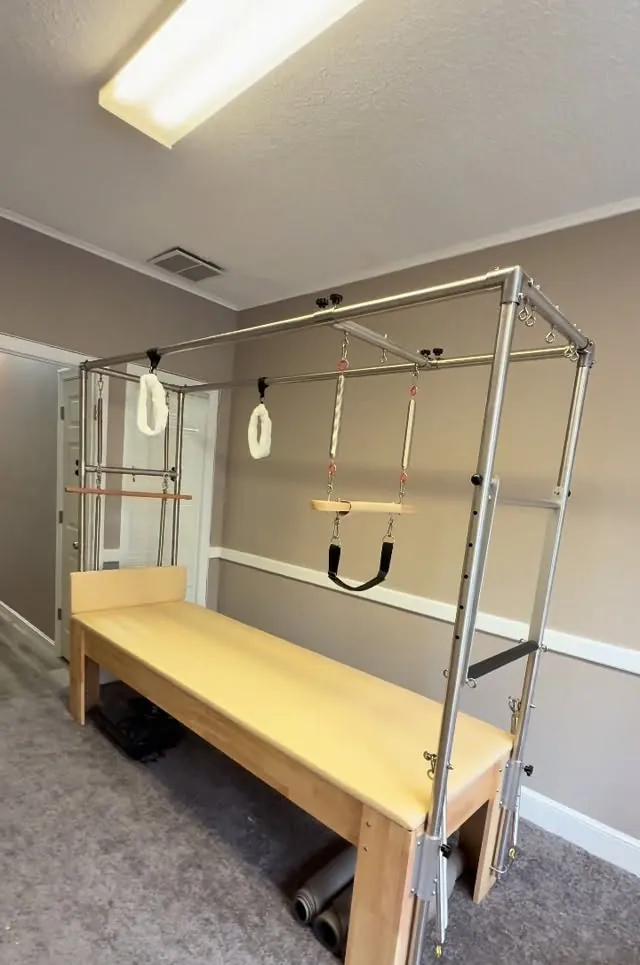
The apparatus is a big help here. The Cadillac, or trapeze table, is a raised, stable surface that is easier to get onto than the floor, with bars and springs that can support the body through movements. The Reformer lets you work lying down with the springs helping or challenging you. The Ladder Barrel offers supported stretching for the spine and hips.
A duet session, with a spouse or friend, is another nice option. Two people share the session with one instructor, which can make it more social and more fun.
What a first session looks like
Your first session starts with a conversation about your health, your activity level, your goals and anything your doctor has advised. Then your instructor will choose a few simple exercises, often starting lying down on the Reformer or Cadillac with gentle footwork and breathing.
Every exercise is explained before you do it. You will be encouraged to move slowly and stop any time something feels uncomfortable. The focus is on learning to breathe with the movement and to feel the muscles that support your posture. For more detail, read what to expect at your first private Pilates session.
Focus areas that often matter most
Balance. Standing work, done close to support, can help you feel steadier. Your instructor can progress it gradually as your confidence grows.
Posture. Exercises that open the chest and strengthen the upper back and shoulder blades help counter the forward rounding that comes from years of sitting, reading and driving.
Hips and legs. Strong legs and hips make it easier to climb stairs, get out of the car and rise from a chair. Footwork and leg exercises on the springs build this strength with low impact on the joints.
Breathing and relaxation. Many older clients enjoy how calm they feel after a session. Focused breathing is a core part of the method.
Moving into group classes
Once you feel comfortable with the basics, a small group class can add variety and social connection. Our Mat Pilates classes are limited to five people, so the instructor can still keep an eye on everyone. Mat work does involve getting down to and up from the floor, so discuss with your instructor whether it suits you yet.
How often should you come? For many older adults, two sessions a week is a good rhythm. Our guide on how often to do Pilates each week explains how to find yours.
Getting started in Lowell and Chelmsford
We teach by appointment at our studio in downtown Lowell and at our Chelmsford studio, with morning sessions available on weekdays and Saturdays. If you have questions, or if a family member is calling on your behalf, we are happy to talk it through first.
A trial class is $30 and is the simplest way to see whether Pilates feels right for you. Everything about booking is on our new clients page.
Frequently asked questions
- Is Pilates safe for seniors?
- For many older adults, Pilates is a gentle, low impact option because exercises can be adapted and supported by springs. Talk to your doctor first, especially if you have low bone density, a joint replacement or heart concerns.
- Am I too old to start Pilates?
- Many people start Pilates in their sixties, seventies and beyond. What matters is starting at the right level, with an instructor who adapts each exercise to your body.
- Do I need to get down on the floor for Pilates?
- Not necessarily. Apparatus like the Cadillac and Reformer are raised off the floor, and many exercises can be done seated or standing. Mat classes do involve floor work.
- Can I do Pilates with osteoporosis?
- Many people with low bone density do Pilates with modifications, often avoiding deep forward bending under load. Ask your doctor what is recommended for you and share it with your instructor.
Found this helpful? Make us a preferred source on Google.
Ready to book your session?
Private, duet and mat Pilates by appointment in Lowell and Chelmsford, MA. We reply personally.